
How an automotive importer and distributor can lead its market with AI
Rivals, dealer pricing, loan rules, fuel prices and owner pride: eight signals every vehicle distributor faces, and how AI helps you act on them first.

If you import and distribute vehicles, you already know the monthly registration figures. You know your share, your best sellers and roughly what your rivals sold. What the figures cannot tell you is why they moved, or what is about to move them next.
In a market like Sri Lanka’s, the “why” changes fast. Import rules open and close. The Central Bank changes how much buyers can borrow. Fuel prices are revised every month. Dealers set their own offers. Buyers, owners and rivals talk about all of it, every day, in Sinhala, Tamil and English.
This guide walks through eight signals that every importer and distributor faces, again and again. Each one is illustrated with real examples from Sri Lanka’s market in 2026, from one of the country’s largest importers and distributors, with names removed. Read it as a checklist for your own brand.
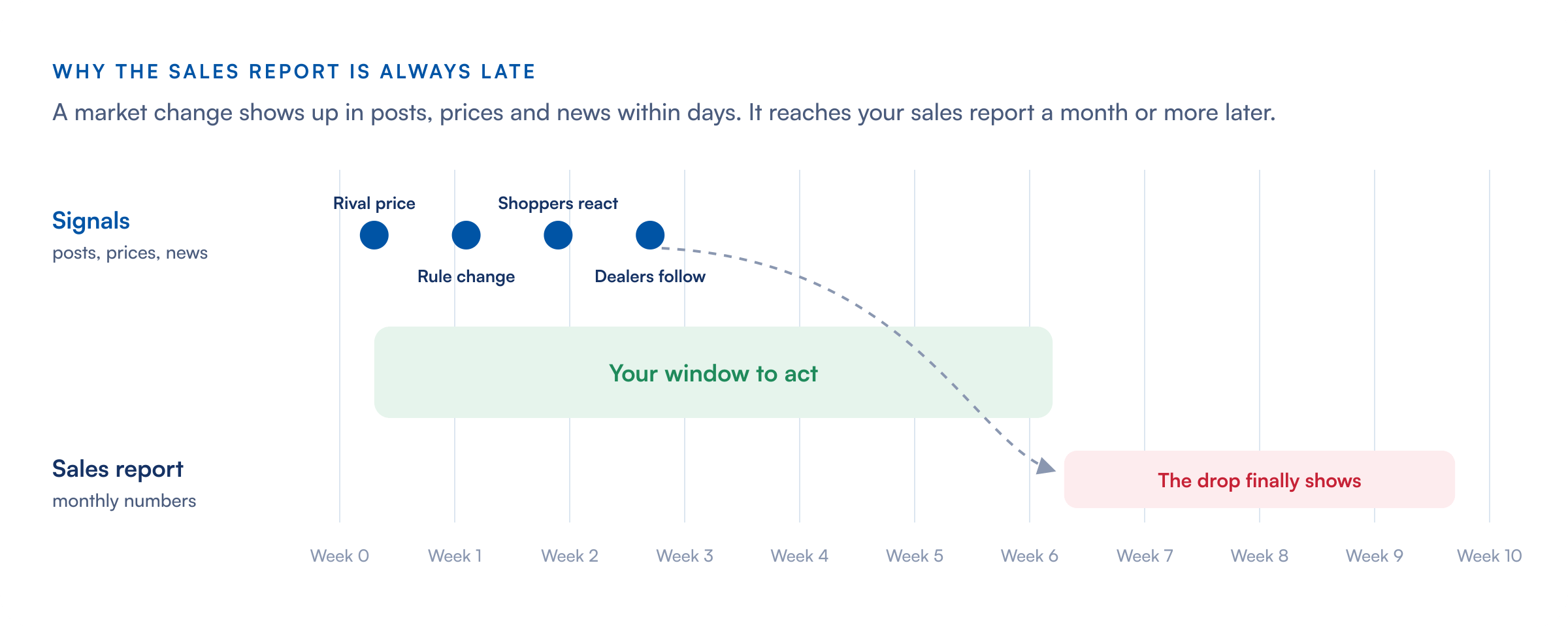
Registration data is the most trusted number you have. It is also the slowest. By the time a dip shows up, the cause is usually a month or two old: a rival’s new model, a dealer’s discount, a rule change, a rise in fuel prices.
The same changes show up much earlier in public: in dealers’ posts, in news reports, in owners’ videos and in buyers’ questions. The job is to catch them in that window, connect them to your brands and models, and decide what to do while it still matters.
Eight signals to watch, and what to do about each
1. A rival wins through a segment you barely play in
Rivals rarely beat a market leader head-on. More often they grow a segment the leader has neglected, and overtake on total volume.
Example from 2026: a rival passed the market leader on total registrations for two months running, by about 8% in the second month. It did so by winning a lighter, easier body style bought mostly by working parents and delivery riders. The leader’s only model there was electric, drew 37 posts in 26 weeks, and only 14% of them came from owners. Rival dealers advertised “Rs. 6,000 a month, no petrol”.
What to watch: your share by segment, not just in total; how rivals’ dealers pitch the segments you are weak in; who is buying there. What to do: get your model into the showrooms where rivals’ models sit, match the way they talk about price (monthly, not total), and use the data to build the case for a better-fitting model.
2. Dealers set a price you never set
Your list price is one price. Your dealers’ offers are the prices buyers actually see.
Example from 2026: dealers from the far north to the east coast posted the same offer for an older-spec version of a best seller, close to Rs. 190,000 below the current model, with a fixed down payment. Buyers began asking whether the price had dropped. Reviewers compared the two versions and said local mechanics know the older one better.
What to watch: dealer offers across districts, the reference price buyers quote back, and how reviewers compare your variants. What to do: publish one official price ladder that shows what the extra money buys, and give mechanics and dealers a short explainer on servicing the newer version.
3. Finance rules change what every offer means
When borrowing rules change, buyers re-read every advertisement through the new rule, usually reduced to one number.
Example from 2026: when the Central Bank tightened loan-to-value limits in May, news pages in Sinhala, Tamil and English summed it up within a day as “60% cash upfront”. Some dealers kept advertising down payments far below that, along with “one-day approval” and “1% interest”.
What to watch: central bank and finance-company announcements, how the news simplifies them, and dealer finance claims. What to do: issue a dealer standard for finance messages that matches the rules and names the finance partner, because an offer that looks too good reflects on your brand, not just the dealer.
4. Fuel prices push buyers towards electric, but only if owners say so
Every fuel revision is watched closely. A sharp rise brings electric models into the conversation.
Example from 2026: petrol 92 rose from Rs. 317 in January to Rs. 434 at the end of May, then settled at Rs. 414. Hire vehicles faced a weekly fuel quota. Dealers sold an electric model on Rs. 60,000 to 70,000 a month in fuel savings, while a locally built electric rival was celebrated as national pride at about Rs. 2 per kilometre. The leading brand had the longest certified range in its class, and no owner talking about it.
What to watch: fuel revisions, quota changes, and who is speaking about electric: dealers, rivals or real owners. What to do: film owners’ real monthly savings, home charging and range on hill roads, and tell your local assembly and service story before a rival owns “made here”.
5. Your owners are your best marketing
Pride of ownership travels further than any dealer advertisement.
Example from 2026: young owners rebuilt and restyled entry-level models and filmed every stage. One of the most-watched posts in the data is a young man showing his mother his new vehicle. Across 26 weeks, owners made 57% of the brand’s posts and got about 1.5 times the engagement of dealer posts, which were mostly price lists and phone numbers.
What to watch: the share of your brand’s posts that come from owners, and which owner content travels. What to do: repost owners’ builds with their name and town, give dealers a handover template instead of price-and-number creative, and track owner share as a monthly measure.
6. A discontinued model still has buyers
When you stop selling a model, its buyers do not disappear. They go to the used market, or to a rival.
Example from 2026: young first-time buyers kept asking for a light, economical model the brand had stopped selling. Used ones were advertised from Rs. 40,000 to 65,000 down, while its intended successor was sold almost only through dealer offers starting at Rs. 190,000 down.
What to watch: questions and used listings for models you no longer sell, and the entry price of your nearest current model. What to do: position the successor clearly as the replacement, with an entry payment first-time buyers can manage, timed for the new registration year.
7. Models appear that you do not distribute
Parallel and grey imports reach dealers before they reach your reports.
Example from 2026: within four days, three dealers in Jaffna posted launch videos for a “legend returns” model that was not on the distributor’s published line-up, “available immediately”. Only 5% of the brand’s posts were in Tamil.
What to watch: dealer launches of models outside your line-up, and your brand’s voice in each language and region. What to do: confirm the supply route quickly, then explain your official warranty and genuine parts in the local language, so that problems with other stock do not land on your brand.
8. Policy and pay move demand before the Budget does
Government announcements change who can buy, and when.
Example from 2026: police said leasing companies could not repossess vehicles by force, and a lease-payers’ association celebrated it to tens of thousands of views. A proposed minimum age for hire drivers drew angry replies from young people who start earning that way. A public-sector pay rise was announced for January.
What to watch: leasing, licensing and pay announcements, and how people react to them. What to do: pause aggressive “easy finance” creative when trust in lenders is low, and time offers for government employees to land when the pay rise does.
What people actually posted
Real Sri Lankan posts from 2026, translated where needed, with names and handles removed. Posts like these appear every year; the topics change, the pattern does not.
“Leasing companies cannot take vehicles by force. It needs a court order.”
A lease-payers’ association page, Facebook reel, Sinhala (translated), 9,880 engagements
“New vehicle loan rules shock Sri Lankan car market! You may need 60% cash upfront now!”
A news creator, TikTok, Tamil with English subtitles, 8,546 engagements
“Here is why vehicle prices in Lanka go sky high: tax on tax.”
A political commentary page, Facebook reel, Sinhala (translated), 13,614 engagements
“Amma, this is the one I told you about.”
A young owner, TikTok, Sinhala (translated), 54,160 engagements
“Before you sign as a lease guarantor, know the law.”
A legal-awareness creator, TikTok, Sinhala (translated), 3,718 engagements
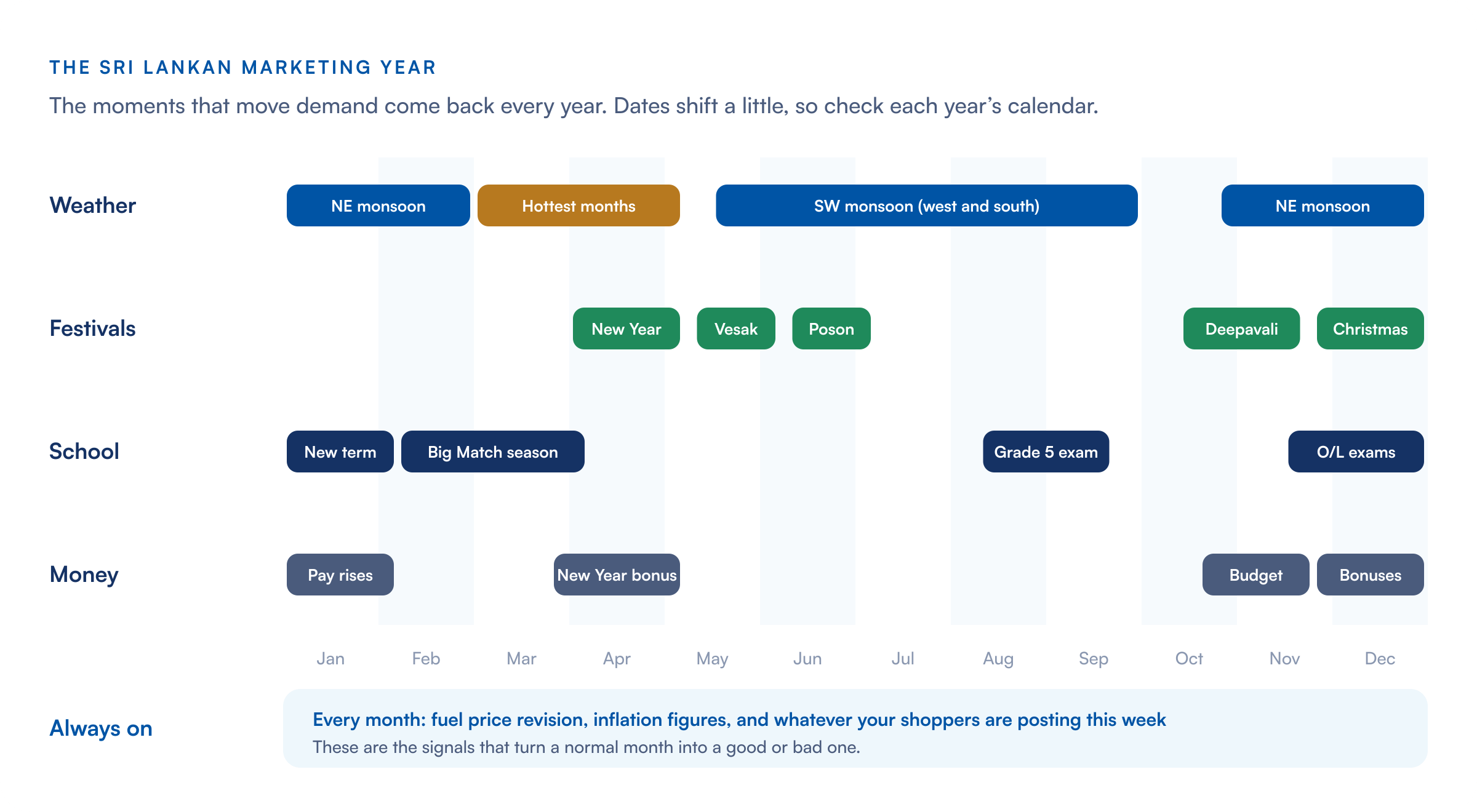
Your year at a glance
The same moments shape a distributor’s year, every year. Plan around them, and watch how each one plays out this time.
Why AI changes the job
You could find each of these signals by hand. The hard part is finding all of them, every week, in three languages, across thousands of posts, dealer ads, price lists and news reports, and then connecting them to your registrations and to the decisions you can actually make.
That is what Forevate does. For the brand in this guide, it read 8,532 public posts over 26 weeks, kept the 77 signals that mattered, tagged each to product, price, place or promotion, and checked them against registrations and public sources. Every signal shows the posts behind it and how sure we are. Your team decides what to do.
For an importer and distributor, the result is simple: you see a rival’s move, a dealer’s price, a rule change or a fuel rise while there is still time to act, not after the monthly numbers arrive.
See what your market is saying about your brand. Start a free 30-day pilot, with first insights in 14 days. Related: why the sales report misses market signals and how to explain a demand spike.
Related resources
 Article
How a beverage brand can win the rain, the power cuts and the Big Match with AI
Weather, power cuts, price and the calendar decide whether your drink sells. How a beverage brand can read these signals by district, before sales move.
 Article
How a biscuit brand can win its market with AI
Launches that outrun the shelf, packs judged on camera, fans who out-market your campaigns: eight signals every biscuit brand faces, and how to act first.
 Article
How a soap brand can protect its price and its shelf with AI
Shrinking packs filmed on camera, floods, small-shop stocking and festive moments: the signals that decide a soap brand's share, and how to see them first.