
How a beverage brand can win the rain, the power cuts and the Big Match with AI
Weather, power cuts, price and the calendar decide whether your drink sells. How a beverage brand can read these signals by district, before sales move.
Your drink is bought on impulse, in a few seconds, at the counter of a small shop, from a fridge that may or may not be cold. Whether it sells depends on things your sales report never shows: the weather that afternoon, whether the shop had power, what your bottle costs next to a cup of tea, and whether there is a match on.
This guide is written for soft drink, juice, water and ready-to-drink brands. The brand in its examples is illustrative, a composite of the challenges such brands face. The market signals and posts are real, taken from Sri Lankan news and social media in 2026. The patterns come back every year.
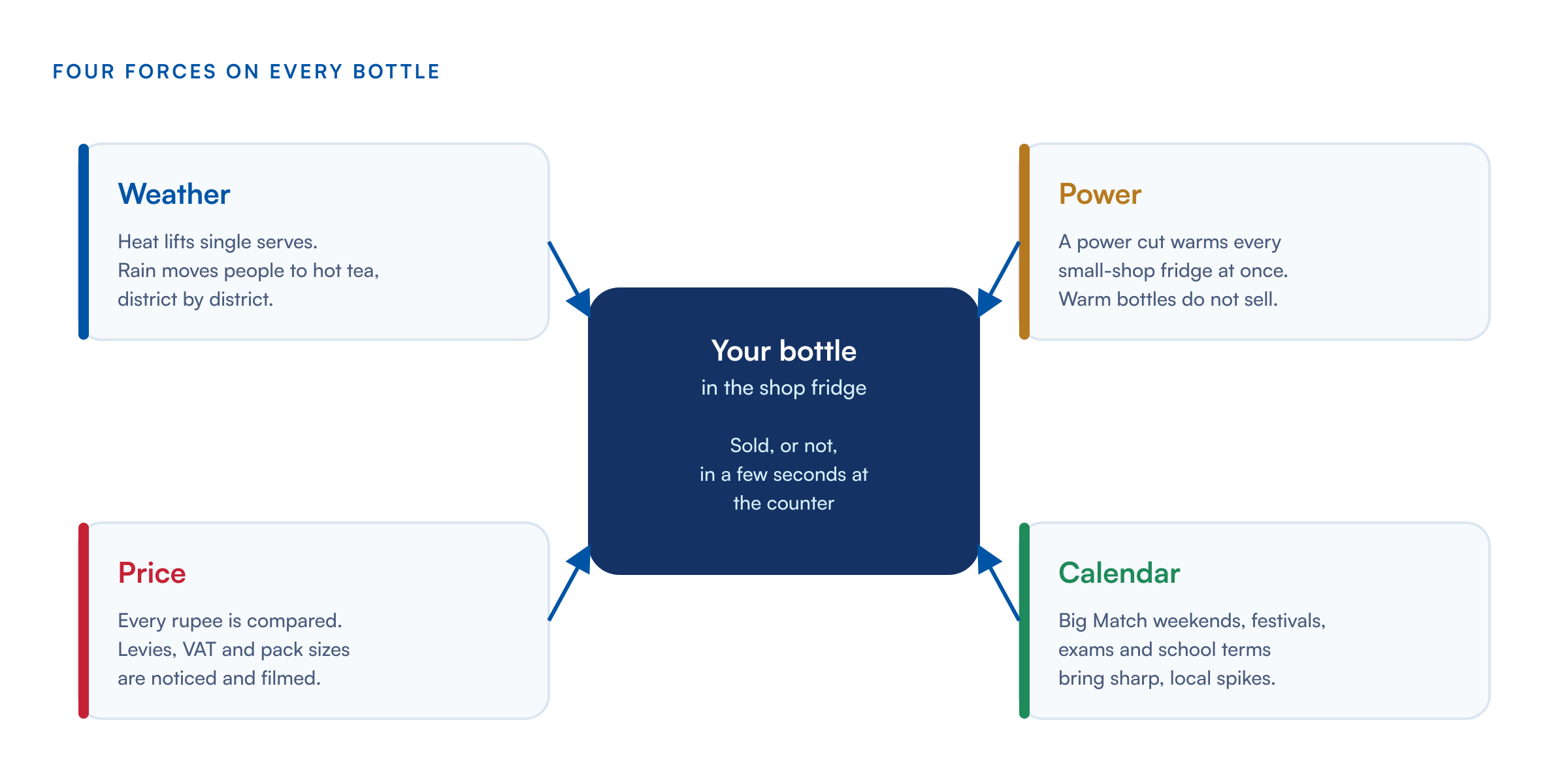
Four forces on every bottle
Five signals to watch, and what to do about each
1. The fridge is the product
A cold drink that is warm does not sell. Power cuts, which Sri Lanka knows well, switch off thousands of shop fridges at once.
Example from 2026: when power failed across the island in October, news pages showed fuel queues the same evening and creators told people to switch off home solar systems. Behind those posts was a quieter effect: small-shop fridges going warm everywhere at the same time.
What to watch: outage reports by area, and which of your top small-shop accounts sit inside them. What to do: have a plan ready, such as cooler boxes, ice credit or a generator partner for key shops, and trigger it within hours, not days.
2. Rain moves demand from cold to hot
On a wet day, people reach for tea, not a chilled bottle. Because the monsoons hit different regions at different times, the effect is local.
Example from 2026: weather services warned of heavy El Niño rain and flash floods from mid-October, and people posted floods as they happened, from a bus wading through Kandy to a hill town under water.
What to watch: rain forecasts and flood posts by district, week by week. What to do: shift promotional spend by district using the forecast; push take-home packs in wet areas and single serves where it is dry. A flat national promotion during a wet fortnight wastes money in the wettest districts.
3. Your daytime rival is the office tea
Some of the most-watched posts about everyday drinking are jokes about office tea: watery cups, the long wait for the tea break, colleagues swapping snacks.
What to watch: what people drink at work and when. What to do: compete for the moment tea does not own. In our illustrative example, the brand tests an afternoon office pack, chilled and delivered, aimed at the 3 pm slump rather than at tea itself.
4. Price is judged in public, in rupees
Example from 2026: a food vlogger visibly objected to a Rs. 5 rise on a supermarket item. Students filmed Rs. 200 meals and judged everything by cost. A Sinhala tutor explaining VAT drew thousands of reactions with “there’s really no getting ahead for us”. Abroad, shoppers weigh packs on camera to expose shrinkflation. Sugar levies and VAT changes keep pressure on sweetened drinks every year.
What to watch: price talk about your category, rival price moves by channel, and tax announcements. What to do: keep a hero price point people can remember, and if a levy or tax forces a change, explain it before someone else does. A bottle that quietly shrinks will be noticed.
5. The Big Match matters more than a festival greeting
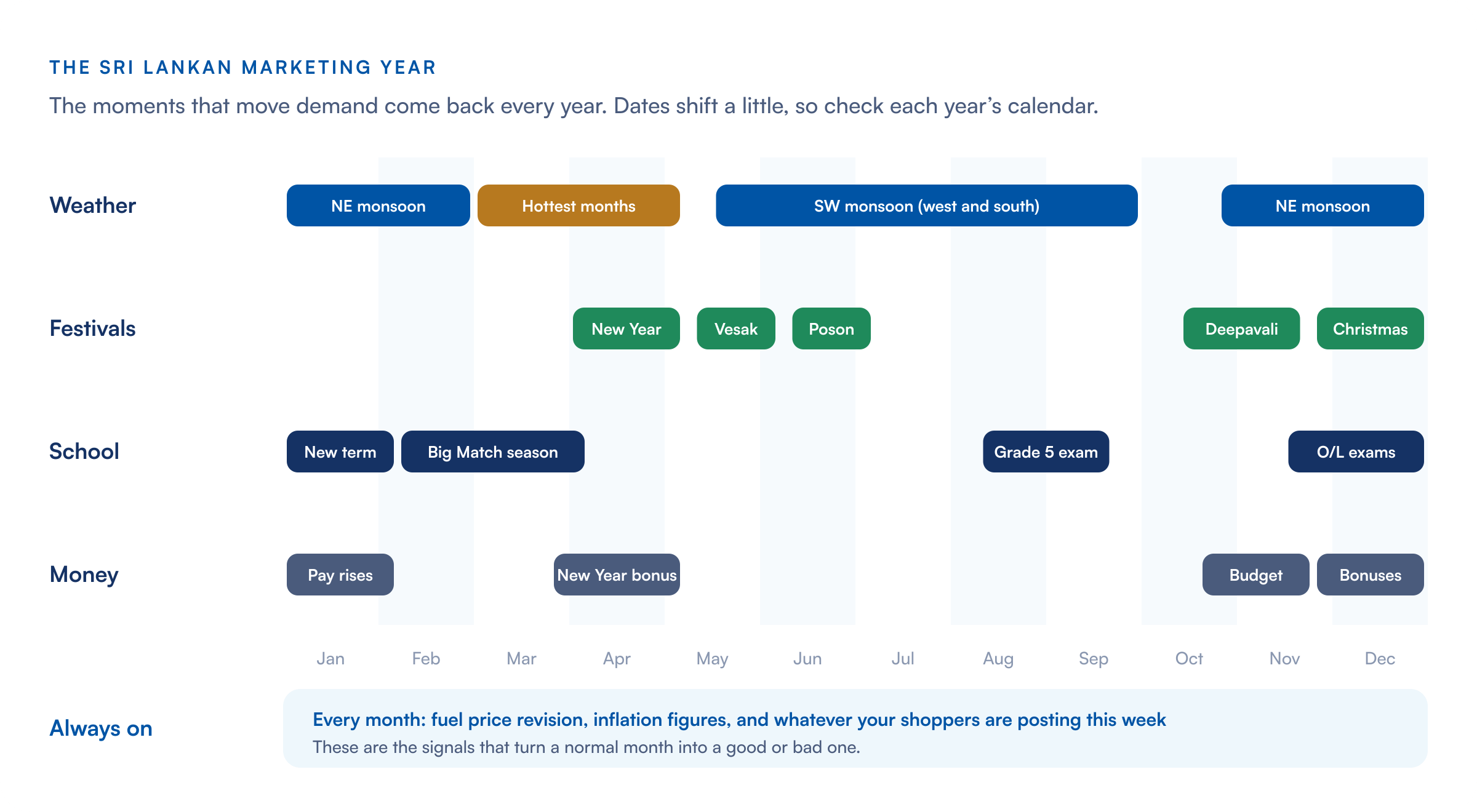
School Big Match season brings some of the biggest single-serve weekends of the year. Generic festival greetings from brands, by contrast, get little attention.
What to watch: fixture announcements and old-boys’ pages counting down to matches; festival talk in the regions where each festival matters. What to do: plan school-by-school match activations early, and replace generic greetings with something specific and local, such as Deepavali sweets pairings in the North and East.
What people actually posted
Real Sri Lankan posts from 2026, translated where needed, with names and handles removed. The dates change; posts like these come back every year.
“Power outage across the country! An important announcement from the Ministry of Power.”
A radio station, TikTok, Tamil (translated), 5,839 engagements
“Fuel queues after the power failure.”
A national TV news channel, TikTok, Sinhala (translated), 2,079 engagements
“From next week, El Niño heavy rain and floods across the country.”
A national TV news channel, TikTok, Sinhala (translated), 7,777 engagements
“Floods.”
A commuter filming from a bus in Kandy, TikTok, Sinhala (translated), 5,286 engagements
“The office tea.”
An office worker, TikTok, Sinhala (translated), 15,387 engagements
“There’s really no getting ahead for us, son.”
A tutor explaining VAT, TikTok, Sinhala (translated), 6,893 engagements
What a week can look like
In our illustrative example, the brand’s Monday briefing reads like this:
- Place: heavy rain forecast for three hill districts from Wednesday. Expect lower single-serve demand there; move two days of cooler stock to the dry south.
- Place: outage reports in three Western Province areas last night. Check cooler status at the top 40 small shops there.
- Price: a rival’s 1 litre bottle is Rs. 20 cheaper in two supermarket chains. No shopper reaction yet.
- Promotion: four Big Match weekends announced. School pages are already counting down.
Every line links to the posts, forecasts and prices behind it, with how sure the system is. Your team decides what to do.
Your year at a glance
Why AI changes the job
Any beverage team can check the weather. What no team can do by hand is read the weather, power outages, prices, festival calendars and thousands of Sinhala, Tamil and English posts every day, by district, and connect them to its own sales.
That is the work Forevate does. It reads every signal, tags it to product, price, place or promotion, and shows the likely effect on your demand before the sales report does. You decide what to move, where and when.
See what is moving demand for your drinks. Start a free 30-day pilot, with first insights in 14 days. Related: how a biscuit brand can win its market with AI and what-if questions before they happen.
Related resources
 Article
How an automotive importer and distributor can lead its market with AI
Rivals, dealer pricing, loan rules, fuel prices and owner pride: eight signals every vehicle distributor faces, and how AI helps you act on them first.
 Article
How a biscuit brand can win its market with AI
Launches that outrun the shelf, packs judged on camera, fans who out-market your campaigns: eight signals every biscuit brand faces, and how to act first.
 Article
How a soap brand can protect its price and its shelf with AI
Shrinking packs filmed on camera, floods, small-shop stocking and festive moments: the signals that decide a soap brand's share, and how to see them first.