
How a stationery brand can win the exam season and back-to-school with AI
Exams, book lists, pay rises, power cuts and floods decide what goes in a school bag. How a stationery brand can read these signals before the season.

If you make exercise books, pens or school supplies, you sell most of your year in a few weeks. In Sri Lanka those weeks are set by the school calendar, the exam timetable and what parents can afford that month. Miss the window and the book list is already filled with someone else’s books.
This guide is written for stationery and school-supplies brands. The brand in its examples is illustrative, a composite of the challenges such brands face. The market signals and posts are real, taken from Sri Lankan news and social media in 2026. The patterns come back every school year.
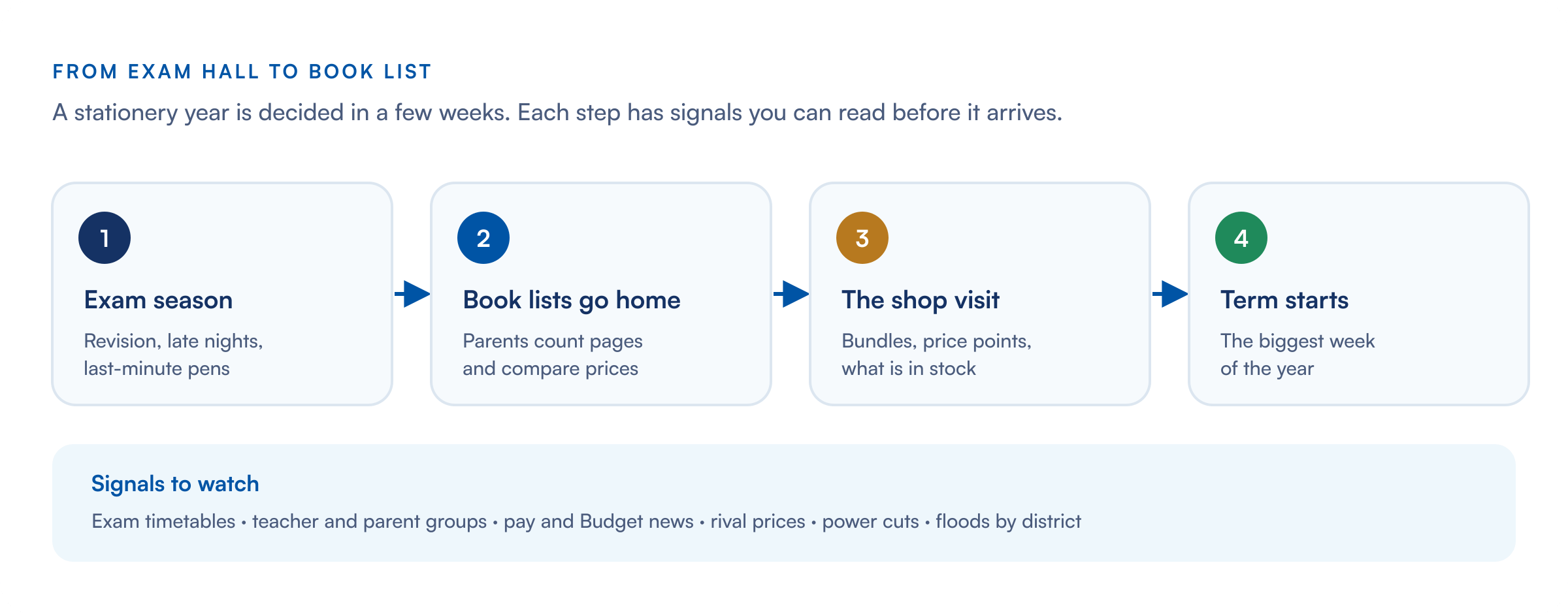
1. Parents feel the exam pressure, and many want to ease it
Every exam season brings the same debate: marks versus wellbeing. A stationery brand sits right at that tension.
Example from 2026: around Children’s Day, adults online said children had lost outdoor play to exams, and a campaign asking parents to ask “were you happy today?” instead of “what rank did you get?” drew wide coverage. A national TV channel’s skit put it bluntly: the exam doesn’t matter, play does.
What to watch: how parents and teachers talk about exams in the weeks before them. What to do: move your exam-season message from “score higher” to “prepare calmly”, with free revision timetables and a note for parents.
2. Pay changes decide what goes in the bag
Teachers and government families are a large share of school-book buyers. When their pay changes, so does the basket.
Example from 2026: in October the President said a teacher earning Rs. 38,000 when the government took office would earn Rs. 65,000 by January, with rises for other public servants too. The Budget a month later was due to confirm the details.
What to watch: pay announcements, the Budget and bonus season. What to do: time your premium range (better paper, branded bags, geometry sets) for the month extra money arrives, and give teachers a reason to recommend it.
3. Every rupee on the book list is compared
Example from 2026: a Rs. 5 rise on a supermarket item was called out on camera. University students judged every meal by its price. A tutor explaining VAT drew thousands of reactions with “there’s really no getting ahead for us”.
What to watch: price talk in parent groups and rivals’ prices per page. What to do: show the page count large on the cover, offer a complete-grade bundle at one clear price, and keep your basic exercise book at a price parents remember. In our illustrative example, the brand sees a rival’s 120-page book drop by Rs. 15 in one supermarket chain, and parents in two groups noticing, before the season begins.
4. Power cuts change how children study
Example from 2026: when power failed across the island in October, news pages and creators posted the outage and its effects into the night. In exam season, a power cut means revision by candlelight or phone torch.
What to watch: outage news and parents’ posts about studying at night. What to do: offer study-at-night and offline revision products when they matter, such as a revision pack bundled with a rechargeable reading light, sold only in the weeks before exams.
5. Floods take books with them
Monsoon floods return every year somewhere on the island, and families lose school supplies along with everything else.
Example from 2026: weather services warned of El Niño rain and flash floods from mid-October, and people posted towns and roads under water in the hills. The anniversary of an earlier cyclone was a reminder of how many families had lost everything.
What to watch: flood warnings and relief appeals by district. What to do: agree a school-supplies relief kit with relief organisations before the rains peak, and route stock to affected districts’ bookshops ahead of the new term.
What people actually posted
Real Sri Lankan posts from 2026, translated where needed, with names and handles removed. The dates change; posts like these come back every school year.
“A teacher earning Rs. 38,000 when the government took office would see their salary rise to Rs. 65,000 by January next year.”
A news page reporting the President, Facebook, English, 1,256 engagements
“Every day we ask ‘what rank did you get?’. Let’s also ask ‘were you happy today?’”
A creator on a Children’s Day campaign, TikTok, Sinhala (translated), 2,799 engagements
“The exam is no use. Play is what matters.”
A national TV channel’s skit, TikTok, Sinhala (translated), 3,097 engagements
“Power outage across the country! An important announcement from the Ministry of Power.”
A radio station, TikTok, Tamil (translated), 5,839 engagements
“There’s really no getting ahead for us, son.”
A tutor explaining VAT, TikTok, Sinhala (translated), 6,893 engagements
What a week can look like
In our illustrative example, the brand’s briefing in the weeks before the O/L exam reads like this:
- Demand: revision questions are peaking in Sinhala and Tamil groups. Geometry sets and blue pens are the most-mentioned items.
- Price: a rival’s 120-page book is Rs. 15 cheaper in one supermarket chain. Parents in two groups have noticed.
- Place: three districts are still recovering from floods. Bookshops there report low stock ahead of the new term.
- Promotion: teacher pages are discussing the coming pay rise. A teacher-recommended premium bundle would land well.
Each line links to the posts, prices and news behind it, with how sure the system is. Your team decides what to do.
Your year at a glance
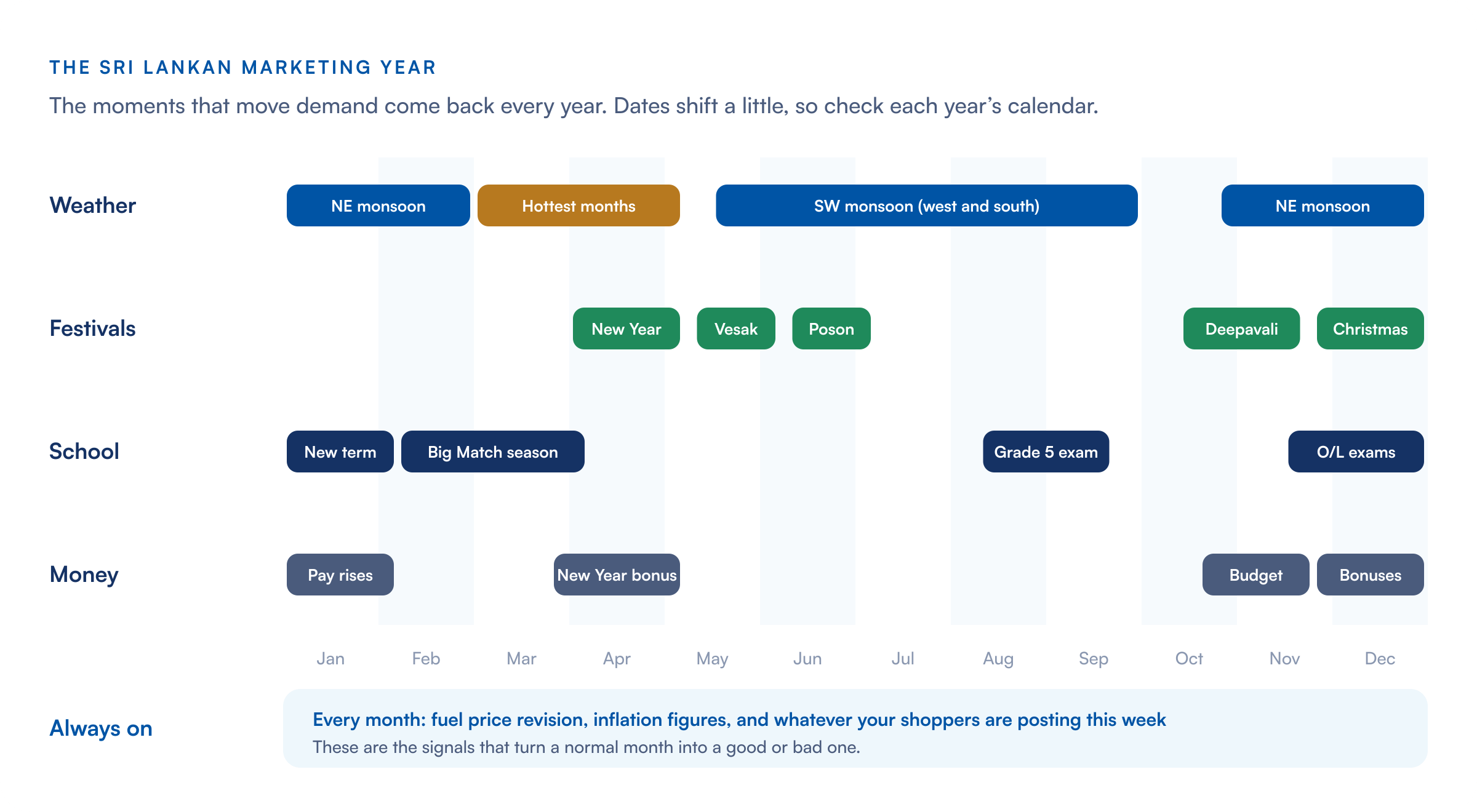
Exam dates move from year to year, so check the Department of Examinations’ calendar each year.
Why AI changes the job
A stationery brand has one big season and very little time to adjust inside it. Forevate reads exam talk, parent groups, prices, weather and policy news every day, in Sinhala, Tamil and English, tags each signal to product, price, place or promotion, and shows where demand is heading by district. You see the book-list season coming, not just the sales after it.
Plan your next season with your market’s signals in hand. Start a free 30-day pilot, with first insights in 14 days. Related: how a biscuit brand can win its market with AI and Forevate and market research.
Related resources
 Article
How an automotive importer and distributor can lead its market with AI
Rivals, dealer pricing, loan rules, fuel prices and owner pride: eight signals every vehicle distributor faces, and how AI helps you act on them first.
 Article
How a biscuit brand can win its market with AI
Launches that outrun the shelf, packs judged on camera, fans who out-market your campaigns: eight signals every biscuit brand faces, and how to act first.
 Article
Forevate vs market research: a partner, not a replacement
Forevate doesn't replace market research. It reads every signal between studies, makes each study go further, and helps you commission fewer, sharper ones.